
Enter “The Capitalist Hell”
Where Harari contradicts his own anti-egalitarianism

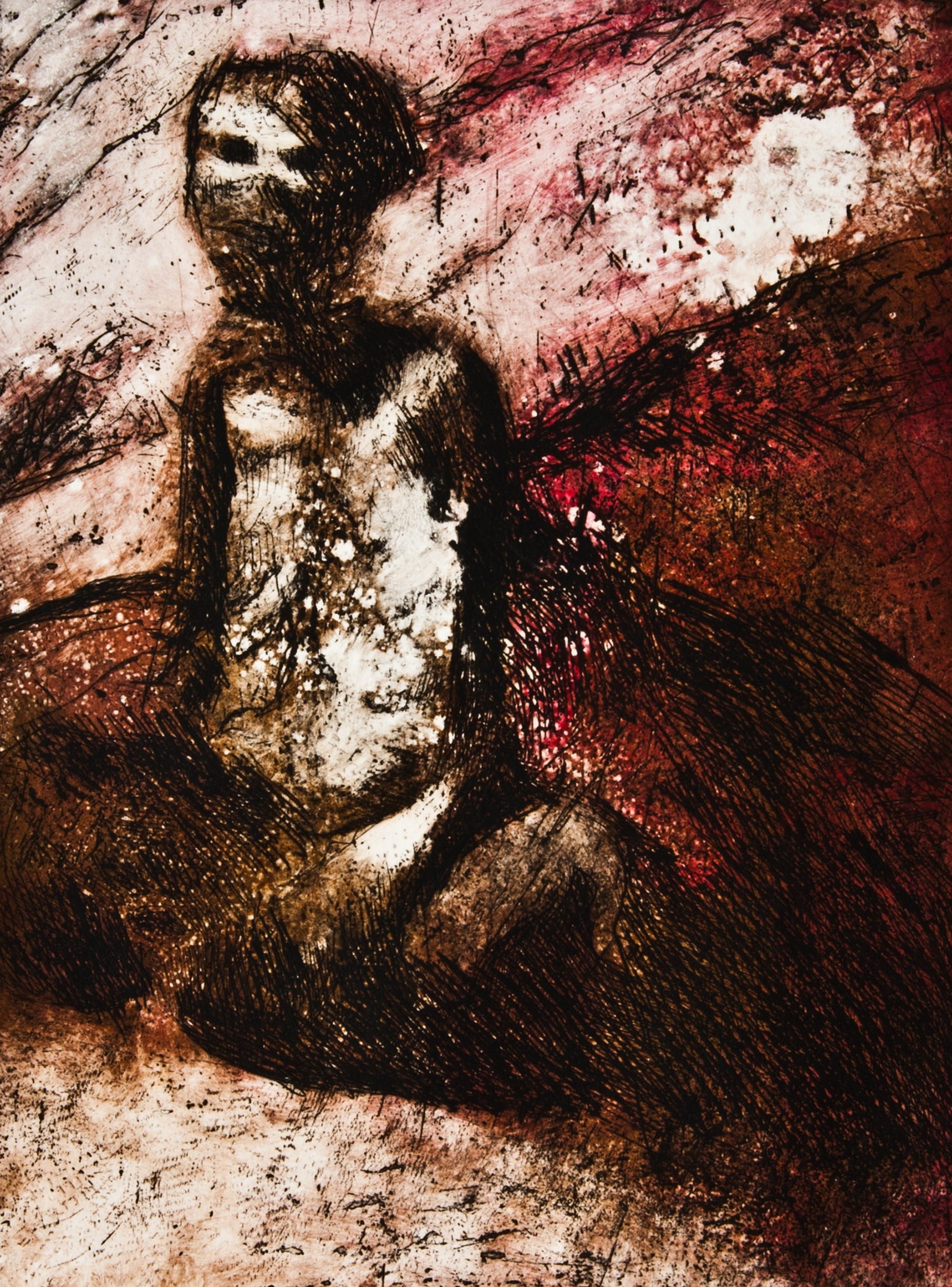
[Etching by April Burke]
Part 2.2 in my critique of Harari’s Sapiens: A Brief History of Humankind.
In the very first essay in this series, I critiqued a claim Harari makes that the values of individual freedom and of equality are irreconcilable, in a logical, universal way because “[e]quality can be ensured only by curtailing the freedoms of those who are better off.”
I argued that the exclusive freedoms of the “better off” are a function of and contingent upon the inequity of society—hence, the reason why equality would mean curtailing those freedoms—and that the recent history of neoliberalism is rife with examples of policy-driven increases in individual freedom for the “better off,” increasing inequality and relatively diminishing individual freedom for the worse off.
However, when it comes to the chapter of Sapiens on capitalism, “The Capitalist Creed,” Harari makes a general case against the unfair distribution of profit which comes with the kinds of market deregulation which has characterized the neoliberal era.
In other words, Harari completely contradicts himself—once again.
Let’s take a closer look at the contradictions which arise in Sapiens when Harari covers the topic of capitalism.
“The Capitalist Hell”
In the chapter, “The Capitalist Creed,” Harari includes some passages which appear highly critical of capitalism, including subheadings like “In the Name of Capital,” “The Cult of the Free Market,” and “The Capitalist Hell.”
In what feels to me like a few moments of lucidity in Sapiens, Harari critiques free-market capitalism:
This is the fly in the ointment of free-market capitalism. It cannot ensure that profits are gained in a fair way, or distributed in a fair manner. On the contrary, the craving to increase profits and production blinds people to anything that might stand in the way.[i]
Despite having an entire chapter titled “There is no justice in history,” Harari uncharacteristically appeals to fairness regarding economic distribution. Similarly, a few pages later, he writes:
The economic pie of 2014 is far larger than the pie of 1500, but it is distributed so unevenly that many African peasants and Indonesian labourers return home after a hard day’s work with less food than did their ancestors 500 years ago.[ii]
Here—despite making numerous anti-egalitarian arguments throughout Sapiens—Harari critiques the increasing inequality that results from unfair distribution of profit under a free market economy.
And he understands the Great Recession as having been driven largely by deregulation of the market:
Markets by themselves offer no protection against fraud, theft and violence. It is the job of political systems to ensure trust by legislating sanctions against cheats and to establish and support police forces, courts and jails which will enforce the law. When kings fail to do their jobs and regulate the markets properly, it leads to loss of trust, dwindling credit and economic depression. That was the lesson taught by the Mississippi Bubble of 1719, and anyone who forgot it was reminded by the US housing bubble of 2007, and the ensuing credit crunch and recession.[iii]
Like some kind of Marxist, he even acknowledges for an instance the dominance and leverage which capitalists have over their workers in a “free market:”
In a completely free market, unsupervised by kings and priests, avaricious capitalists can establish monopolies or collude against their workforces. If there is a single corporation controlling all shoe factories in a country, or if all factory owners conspire to reduce wages simultaneously, then the labourers are no longer able to protect themselves by switching jobs.[iv]
In short, a lot of these passages seem generally agreeable from an anti-capitalist perspective. Indeed, if it weren’t for his other passages claiming the superiority of idealist historiography over materialist, arguing against economic understandings of history, and against causal conceptions of history in general – it might seem for a moment that Harari himself understands history through materialist, economic theories.
He doesn’t actually provide any sort of critique of the economy itself—for example, Marx’s theory actually explains why deregulation during periods like the neoliberal era becomes necessary for counteracting what even the Political Economists before him had defined as a tendency for the rate of profit to fall as the means and forces of production advance in capitalism. However, he does deliver in this chapter what feels like the only sincere reference he makes to Marx among the many throughout Sapiens—although, it’s a reference which includes none of Marx’s analysis of capitalist production itself: “As Marx and other social critics quipped, Western governments were becoming a capitalist trade union.”[v]
Despite what I find to be a generally agreeable tone, there’re several contradictions that arise here in the text, some of which I’ve already touched on above:
As the reader, how does one reconcile a) Harari’s critique here of inequality with b) his many critiques of egalitarianism throughout the Sapiens (as I’ve covered previously)?
How does one reconcile a) his advocacy for regulation with b) his blanket critiques of reform, revolution, and politics in general in a passage some 50 pages later in a reductionist argument about the biochemistry of happiness (as I’ve covered previously)?
How does one reconcile a) his explanation that an unfettered market will inevitably lead to depression with b) his arguments against economic understandings of history, and against causal conceptions of history in general (as I’ve covered previously)?
Capitalism as an ethic
Before I elaborate some more on these contradictions, it’s important to clarify what Harari means when he refers to capitalism.
Despite dropping the term “free-market capitalism,” he is not referring to an economic system, one with laws distinguishable from other economic systems, as Marx and other Political Economists argued; rather, he’s careful to remind us that—at the end of the day, he views capitalism as an ideology and as a religion, on one and the same plane as Christianity and Nazism, and as with other religions, a fanatical adherence to a “supreme good” in the religion of capitalism, “unrestricted by any other ethical considerations […] can easily lead to catastrophe:”
When growth becomes a supreme good, unrestricted by any other ethical considerations, it can easily lead to catastrophe. Some religions, such as Christianity and Nazism, have killed millions out of burning hatred. Capitalism has killed millions out of cold indifference coupled with greed.[vi]
To whatever extent Harari acknowledges the existence of capital, labor, and a capitalist system, he sees such a system as organized around the capitalist creed that reinvesting in production a moral good: “The modern economic system would not have lasted a single day if the majority of investors and bankers failed to believe in capitalism.”[vii] More directly, he writes:
Capitalism began as a theory about how the economy functions. It was both descriptive and prescriptive – it offered an account of how money worked and promoted the idea that reinvesting profits in production leads to fast economic growth. But capitalism gradually became far more than just an economic doctrine. It now encompasses an ethic – a set of teachings about how people should behave, educate their children and even think.[viii]
Far short of any economic definition of capitalism, Harari emphasizes a series of ideological statuses, between theory and doctrine, ethics and norms. Nothing which informs us of any economic-based motives for why capitalists make the decisions they do, or how dynamics internal to capitalist economy might drive an era of deregulation.
Harari against Harari on equality
The last half-century of Neoliberal policies is best characterized by an increase in migratory, international freedom for capital via deregulation, union busting, and austerity which served to increase profits for decades while real wages stagnated and working-class political power diminished significantly. And when deregulation of banks led to a housing crisis, it was the companies that were bailed out, while over 6 million U.S. households went to foreclosure.
This is the kind of problem Harari seems to acknowledge when he writes that “[i]n a completely free market, unsupervised by kings and priests, avaricious capitalists can establish monopolies or collude against their workforces.” That is, is he acknowledges the power relation capitalists have over workers, especially when unrestrained by market regulations. Hence, he emphasizes “It is the job of political systems to ensure trust by legislating sanctions against cheats and to establish and support police forces, courts and jails which will enforce the law.”[ix]
However, supporting regulation of capitalism such that it avoids economic depressions means supporting limitation of exclusive individual freedom of the “better off” and the inequality it produces (including, for example, workers’ rights to unionize being protected against laws like “Right to work.”).
Indeed, regulation to prevent another crash would like look like, at the very least, pro-labor legislation and increased corporate oversight; less “trickle-down economics” (which results in things like stock buy-backs) and more health care and infrastructure. In short, it would require political reforms, ones which are by nature egalitarian.
And yet, a mere 50 pages later, he argues that, based on our knowledge of biochemistry, we can dispense with not only revolution but reform and politics in general.
Let’s, for a moment, give Harari the benefit of the doubt and assume that he doesn’t necessarily mean to own all the implications of the biological view he represents (or for that matter, the other anti-egalitarian arguments he makes). However, if the point was merely to represent various dominant views and to push them to their limits, why does Harari leave such contradictions, not only unresolved, but unacknowledged? He does give one qualifier: that the human need for a meaningful life and the varying meanings people apply to their lives suggests that “the history of happiness might have been far more turbulent than biologists imagine.”
So why wouldn’t he acknowledge that the reductionist biological perspective runs into problems in regard to things like the need to regulate capitalist markets?
I’m afraid we’re being too charitable at this point.
As I’ve explained in a previous essay, the reductionist view of biology which Harari represents is not even agreeable to biologists themselves, and his pitting of biology against egalitarianism, and against the humanities and social sciences in general, as well as his tolerance for mutually incompatible arguments against the revolutionary movement is a common characteristic of counterrevolutionary thought. And I think that’s the only way to ground our interpretation of Harari’s Sapiens. Despite containing passages that advocate for regulation of capitalism, it’s ultimately a reactionary and conservative text.
Despite an agreeably anti-capitalist tone, Harari’s critique of capitalism misses the mark. The problem is not simply that unregulated markets are bad for us, but that dynamics immanent to the capitalist economy are such that they demand that capitalists constantly seek to thwart regulation. In other words, the system is sick, and it can't be sustainably reformed into a friendly, fail-safe version.
Hence, the neoliberal era: when capital runs into its internal limits to profit, it must displace them to survive, including largely through deregulation. The neoliberal era of deregulation is a demonstration of the fact that the greedy drive to exploit is not primarily driven by creed but by needs of capital itself, needs which are justified by the capitalists representing them in a creed, serving to rationalize an otherwise mad system.
Notes
[i]. Harari, Sapiens (New York: HarperCollins, 2015), 331.
[ii]. Ibid, 333.
[iii]. Ibid, 329.
[iv]. Ibid, 329-30.
[v]. Ibid, 325.
[vi]. Ibid, 331.
[vii]. Ibid, 112.
[viii]. Ibid, 314.
[ix]. Ibid, 329-30.